
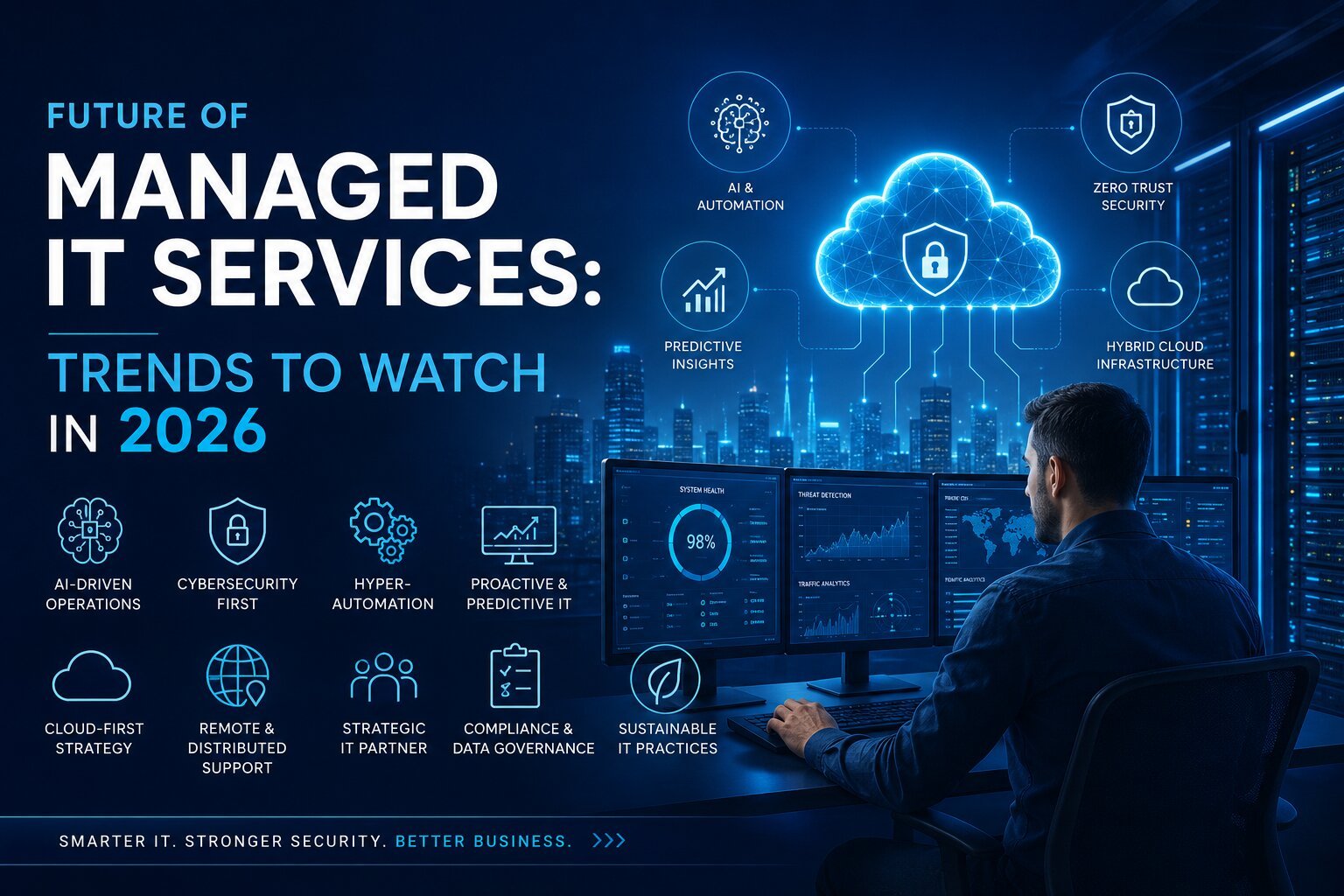
Future of Managed IT Services: Trends to Watch in 2026
Managed IT services have moved far beyond simple helpdesk support and break-fix models. In 2026, they sit at the center of how modern businesses operate, scale, and protect themselves from increasingly complex digital risks. As organizations continue to adopt cloud-first strategies, hybrid work models, AI-driven tools, and stricter cybersecurity requirements, Managed Service Providers (MSPs) are evolving into strategic technology partners rather than just support vendors.
The future of managed IT services is being shaped by automation, artificial intelligence, cybersecurity demands, and the growing need for proactive rather than reactive IT management. Below are the most important trends defining this transformation in 2026.
1. AI-Driven Managed IT Operations Become Standard
Artificial intelligence is no longer an experimental add-on in managed IT services—it is now embedded in core operations.
In 2026, MSPs are increasingly using AI for:
- Predictive maintenance of systems and networks
- Automated ticket resolution for common IT issues
- Intelligent monitoring of infrastructure performance
- Real-time anomaly detection in cybersecurity threats
Instead of waiting for systems to fail, AI tools now help predict failures before they happen. For example, AI can analyze server logs and identify patterns that suggest an upcoming hardware issue, allowing technicians to intervene early.
This shift significantly reduces downtime, improves service reliability, and lowers operational costs for businesses.
2. Cybersecurity Becomes the Core Service Offering
Cybersecurity is no longer a separate service—it is the foundation of managed IT services.
With ransomware, phishing attacks, and supply chain breaches becoming more sophisticated, MSPs are now expected to deliver “security-first” IT environments.
Key cybersecurity trends in 2026 include:
- Zero Trust Architecture becoming the default security model
- Continuous identity verification instead of one-time logins
- AI-based threat detection and response systems
- Automated incident response workflows
Businesses are no longer asking if they need strong cybersecurity—they are asking whether their MSP can provide 24/7 threat prevention and response. Managed IT providers that fail to integrate deep security capabilities risk becoming obsolete.
3. Rise of Hyper-Automation in IT Support
Automation is advancing from simple task scripting to full-scale hyper-automation.
In 2026, MSPs are automating entire IT workflows, including:
- User onboarding and offboarding
- Software deployment and patch management
- Backup and disaster recovery processes
- Network configuration and monitoring
This reduces human intervention in repetitive tasks and allows IT teams to focus on strategic initiatives rather than routine maintenance.
Hyper-automation also improves consistency and reduces human error, which is one of the major causes of IT incidents in businesses.
4. Shift Toward Proactive and Predictive IT Support
Traditional IT support was reactive—something breaks, and then it gets fixed. That model is now outdated.
Modern managed IT services focus on preventing problems before they impact operations. In 2026, predictive IT support is becoming the industry standard.
MSPs are leveraging:
- Machine learning models to predict system failures
- Network performance analytics to detect slowdowns early
- Endpoint monitoring tools to identify vulnerabilities before exploitation
This proactive approach significantly improves uptime and ensures smoother business operations. Companies now expect MSPs to act as guardians of system stability, not just repair teams.
5. Cloud-First and Hybrid Infrastructure Dominance
Cloud adoption continues to grow, but most businesses are not fully cloud-based—they operate in hybrid environments combining on-premises systems with multiple cloud platforms.
Managed IT services in 2026 must support:
- Multi-cloud environments (AWS, Azure, Google Cloud)
- Hybrid infrastructure integration
- Cloud cost optimization strategies
- Secure cloud migration and management
MSPs are also increasingly responsible for helping businesses avoid cloud sprawl and unnecessary costs by optimizing resource usage across platforms.
The complexity of managing hybrid systems is pushing businesses to rely more heavily on expert managed service providers.
6. Expansion of Remote and Distributed IT Management
With remote and hybrid work now permanently embedded in business culture, IT support must be location-independent.
In 2026, managed IT services are designed for global accessibility:
- Remote device management for employees anywhere in the world
- Cloud-based collaboration and communication tools
- Secure access management for distributed teams
- 24/7 remote helpdesk support across time zones
This shift means MSPs are no longer bound by geography. A business in Melbourne can be fully supported by a team operating globally, as long as systems are secure and cloud-enabled.
7. Integration of Managed Services with Business Strategy
One of the biggest shifts in 2026 is that MSPs are becoming strategic advisors rather than just technical support providers.
Businesses now expect their IT partners to help with:
- Digital transformation planning
- Technology budgeting and cost optimization
- Scalability planning for growth
- Compliance with data protection regulations
Managed IT providers are increasingly involved in board-level discussions, especially when technology decisions directly impact business outcomes.
This evolution marks a major shift from “IT support” to “business enablement through technology.”
8. Increased Focus on Compliance and Data Governance
With stricter global regulations around data privacy and cybersecurity, compliance has become a major focus area.
MSPs are now responsible for helping businesses comply with frameworks such as:
- GDPR and data protection laws
- Industry-specific compliance standards
- Cybersecurity insurance requirements
- Data retention and governance policies
Failure to comply can result in severe financial and reputational damage, making managed IT services essential for risk management.
9. Growth of Industry-Specific Managed IT Solutions
Generic IT support is becoming less effective as industries become more specialized.
In 2026, MSPs are offering tailored solutions for sectors such as:
- Healthcare (secure patient data management systems)
- Finance (fraud detection and compliance systems)
- Manufacturing (IoT-enabled smart factory monitoring)
- Retail (POS system integration and eCommerce support)
Industry-specific expertise allows MSPs to deliver more value and better understand the operational challenges of their clients.
10. Sustainable and Green IT Practices
Sustainability is now influencing IT decisions as much as performance and cost.
Managed IT services are increasingly focused on:
- Energy-efficient cloud infrastructure usage
- Reducing electronic waste through virtualization
- Optimizing server workloads to lower energy consumption
- Sustainable hardware lifecycle management
Businesses are also using green IT practices as part of their corporate responsibility goals, and MSPs play a key role in enabling these initiatives.
Conclusion
The future of managed IT services in 2026 is defined by intelligence, automation, security, and strategic alignment with business goals. MSPs are no longer just fixing IT problems—they are preventing them, predicting them, and shaping how businesses grow through technology.
As AI, cybersecurity, cloud computing, and automation continue to evolve, managed IT service providers that adapt quickly will become indispensable partners for organizations of all sizes.
For businesses, the message is clear: choosing the right managed IT service provider is no longer just an IT decision—it is a long-term strategic investment in stability, security, and growth.






0 Comments